How Do Toilet Cubicle Hinges Work? A Quick Guide to Gravity & Self-Closing Hinges
15 September 2026
Toilet cubicle hinges are one of the most replaced components in any commercial washroom — not because they wear out quickly when correctly specified, but because they are frequently under-specified and then fail under the conditions they are actually asked to meet. A hinge that corrodes, seizes or loses its self-closing action within a couple of years means a cubicle door that swings open, stays shut when it should not, or has to be manually held shut. None of these is acceptable in a commercial washroom. This guide explains the main types of toilet cubicle door hinges, what each does, and which environment each is suited to.
Key takeaways
Gravity hinges (also called self-closing hinges or self-functioning hinges) use the weight of the door to close it automatically. They are the standard specification for most commercial toilet cubicles.
Rise and fall hinges allow the door to be set to fall open, fall closed, or hold in a neutral position. They are adjustable and suit high-moisture environments well.
Spring-loaded hinges use a concealed spring to close the door. They provide a consistent closing action but can be noisy and lose tension over time.
Nylon hinges are plastic, lower cost and used primarily in children’s school toilet cubicles.
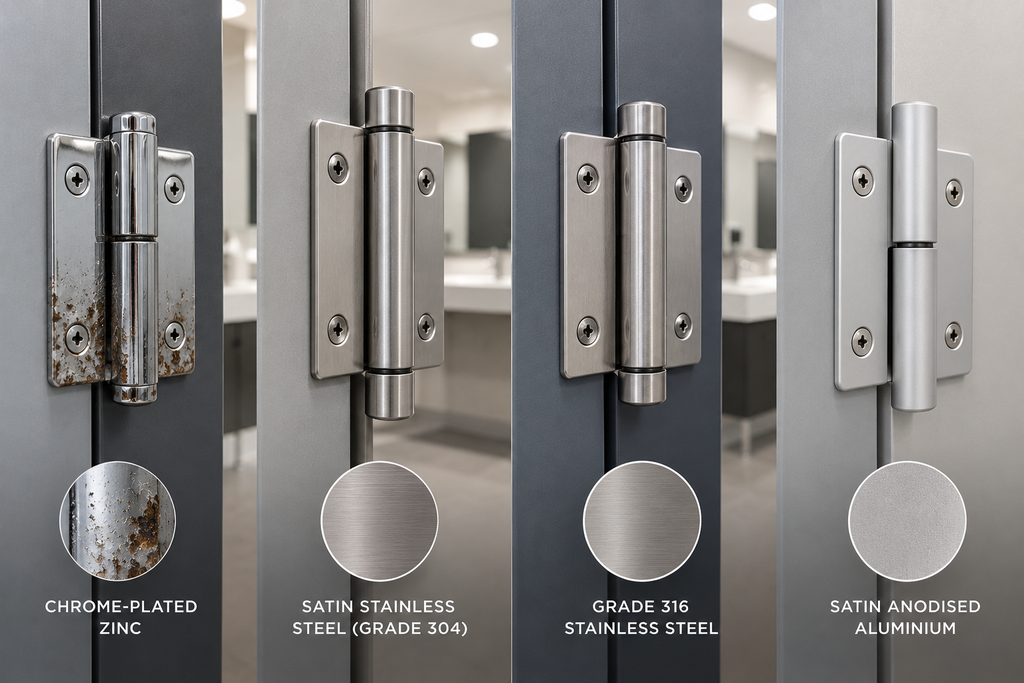
Material matters: chrome-plated zinc corrodes in washroom conditions; stainless steel (grade 304 for standard, grade 316 for wet areas) is the correct commercial specification.
Panel thickness must match the hinge. The three common panel thicknesses — 12–13mm, 17–19mm, and 20–21mm — each require a different hinge depth. Fitting the wrong size causes the door to bind or not close correctly.
What are toilet cubicle hinges?
Toilet cubicle hinges are the pivot mechanisms that attach the cubicle door to the front pilaster (the vertical post that forms the front edge of the cubicle). In a standard commercial toilet cubicle, two hinges are fitted — one near the top of the door and one near the bottom — and the hinge type determines how the door behaves when released: whether it swings closed automatically, holds wherever it is left, or falls open.
Unlike standard door hinges, toilet cubicle hinges are designed for doors that are lighter than a standard interior door, are opened and closed many times a day, and are exposed to humidity, condensation and cleaning chemicals. The hinge mechanism needs to function reliably for the full service life of the cubicle — typically fifteen to twenty years in a correctly specified solid grade laminate system.
What is a gravity hinge for toilet cubicles?
A gravity hinge — also called a self-closing hinge or self-functioning hinge — uses the weight of the door itself to create a closing action. The mechanism is an off-centre pivot: when the door is released, the weight of the door acts on the offset pivot point and pulls the door closed, in the same way that an off-balance pendulum swings to its lowest point.
Gravity hinges for toilet cubicles are adjustable: the pivot can be set to pull the door closed, to push it open, or to hold it in a neutral position. The standard commercial setting is closed — the door swings shut when released, which is the expected behaviour in a public or commercial washroom. Some facilities managers prefer the open setting in accessible cubicles, so a vacant cubicle is clearly visible.
The main advantages of gravity hinges are simplicity and longevity. There are no springs to lose tension, no hydraulic fluid to leak, and no mechanism to seize. A stainless steel gravity hinge correctly installed will function reliably for the life of the cubicle with no maintenance other than an occasional check on the fixing screws.
What is a rise and fall hinge?
A rise and fall hinge is an adjustable type of gravity hinge where the pivot geometry causes the door to rise slightly as it opens and fall as it closes. The rising action means the door lifts over any minor floor irregularity as it swings open, which prevents it from dragging or catching on uneven floors. The falling action on closing ensures the door pulls down into the closed position rather than just swinging to a stop.
Rise and fall hinges are particularly well suited to high-moisture environments where the floor may be wet or where the cubicle base may move slightly with temperature and humidity changes. They are available in adjustable versions that can be set to fall open or fall closed, and in non-adjustable versions with a fixed closing action.
In UK commercial washroom specification, rise and fall hinges and gravity hinges are often used interchangeably as terms, and many products marketed as gravity hinges incorporate the rise and fall geometry. The practical distinction for most specifiers is whether the hinge is adjustable (allowing the closed/open/neutral setting to be changed on site) or fixed.
What is a spring-loaded toilet cubicle hinge?
A spring-loaded hinge uses a concealed internal spring to return the door to the closed position. Unlike a gravity hinge, which relies on the door’s weight and the offset pivot, a spring hinge provides a consistent closing force regardless of how the door is positioned — it will close whether the door is held at 30 degrees or 90 degrees.
Spring-loaded toilet cubicle hinges were the standard commercial specification before gravity hinges became widespread. They provide a reliable closing action but have some disadvantages compared to gravity hinges: the spring can lose tension over time, particularly with heavy daily use; the closing action can be abrupt and noisy; and the spring mechanism adds a failure point that gravity hinges do not have.
Adjustable spring hinges allow the tension to be set on site, which is useful for matching the closing speed to the door weight. Concealed spring hinges with covering plates give a cleaner appearance and resist vandalism in environments where exposed fixings are a concern.
What is a nylon toilet cubicle hinge?
Nylon hinges are plastic hinges used primarily in children’s toilet cubicles in schools, nurseries and leisure centres. They are lower cost than stainless steel options, available in colours that coordinate with colourful school cubicle schemes, and sufficient for the lighter doors and lower usage levels of a junior or infant toilet cubicle.
Nylon hinges are not appropriate for adult commercial washrooms or any high-traffic environment. They do not provide a reliable self-closing action in the same way as a gravity or rise and fall hinge, and they are less resistant to physical abuse than metal alternatives. In a school, the distinction is usually clear: nylon hinges for the children’s cubicles, stainless steel for the staff and adult facilities.
Toilet cubicle hinge types compared
Hinge type
Closing action
Best for
Not suitable for
Gravity / self-closing
Auto-closes via offset pivot
Commercial offices, leisure, healthcare
Not adjustable on all versions
Rise and fall
Auto-closes, lifts on opening
High-moisture, uneven floors, schools
—
Spring-loaded
Auto-closes via spring tension
Any standard environment
Heavy use (spring fatigue)
Nylon
None or minimal
Children’s cubicles, junior schools
Adult commercial washrooms
Heavy duty
Varies
High-traffic, prisons, public buildings
Light residential use
What material should toilet cubicle hinges be?
Material is as important as hinge type, and it is the most common point where commercial washroom hardware is under-specified.
Chrome-plated zinc is the standard material in budget commercial hardware. The chrome finish looks clean initially but begins to degrade in washroom humidity within two to three years. Once the chrome layer fails, the zinc beneath corrodes quickly. Corroded hinges bind, lose their closing action and become increasingly difficult to clean. In a well-specified cubicle — solid grade laminate panels expected to last fifteen to twenty years — chrome zinc hinges are a false economy.
Satin stainless steel (grade 304) does not corrode in standard commercial washroom conditions. It maintains its finish and function over the life of the cubicle and requires no maintenance beyond wiping down during routine cleaning. Grade 304 is the correct specification for most commercial washrooms.
Grade 316 stainless steel adds additional resistance to chloride corrosion, making it the correct specification for coastal environments, swimming pools and any facility where the cleaning regime uses high-chlorine solutions regularly.
Satin anodised aluminium offers good corrosion resistance and a wider range of finishes. It is lighter than stainless steel and performs well in standard commercial environments, though it is less resistant to physical impact.
Panel thickness and hinge compatibility
One of the most common installation errors with toilet cubicle hinges is fitting a hinge designed for one panel thickness to a panel of a different thickness. The three standard panel thicknesses in UK commercial cubicle systems are:
12–13mm — standard for many flat pack and mid-range systems
17–19mm — used in some higher-specification systems
20–21mm — standard for solid grade laminate commercial systems
A hinge designed for 13mm board fitted to a 20mm panel will not sit flush, will not provide the correct clearance between the door and the pilaster, and may cause the door to bind or not close correctly. Most hinge suppliers clearly specify which board thickness each hinge is designed for. In a bespoke cubicle system manufactured and installed by one supplier — as with BRAC Projects — hinge and panel compatibility is managed as part of the specification; in a self-install flat pack system, it is the installer’s responsibility to confirm before ordering.
When do toilet cubicle hinges need replacing?
Toilet cubicle hinges need replacing when: the door no longer closes under its own action; the hinge body is visibly corroded or pitted; the hinge has worked loose from the panel and the fixing holes are stripped; or the door no longer hangs level, suggesting the hinge geometry has shifted.
In some cases, a hinge that has lost its closing action can be adjusted rather than replaced — gravity and rise and fall hinges have an adjustable element that can be reset with an Allen key. In other cases — particularly when chrome zinc hinges have corroded — replacement is the only option.
When replacing toilet cubicle door hinges, the panel thickness, door weight and desired closing action all need to be confirmed before ordering. Replacing like-for-like is straightforward; upgrading from chrome zinc to stainless steel on an existing cubicle system is also usually possible with the same fixing positions.
Frequently asked questions
What is the difference between a gravity hinge and a self-closing hinge?
The terms are interchangeable. A gravity hinge is a self-closing hinge — it uses the weight of the door acting on an off-centre pivot to close the door automatically. Both names refer to the same mechanism. Rise and fall hinges are a variant of the gravity hinge design that also causes the door to rise slightly on opening.
How do I know which toilet cubicle hinge I need?
You need to know: the thickness of the cubicle panel (12–13mm, 17–19mm, or 20–21mm); the door weight (most standard commercial cubicle doors fall within the weight range of standard gravity hinges, but heavier solid grade laminate doors may require heavy duty versions); and whether you want the door to fall closed or open when released.
Why is my toilet cubicle door not closing properly?
The most common causes are: the hinge adjustment has shifted and needs resetting (use the Allen key on the adjustment screw); the hinge has corroded and the mechanism is stiff or seized; the panel has moved and the hinge is no longer aligned with the keep; or the panel itself has warped, changing the door geometry. Gravity and rise and fall hinges can often be readjusted on site; seized or corroded hinges need replacing.
Can toilet cubicle hinges be replaced without replacing the whole cubicle?
Yes. Toilet cubicle door hinges are a replaceable component. As long as the panel is in good condition and the fixing holes have not been stripped, hinges can be replaced on an existing cubicle system. If the existing panels are MFC and have swollen around the fixing holes, the panel will need replacing along with the hinges.
What hinges are used for school toilet cubicles?
Children’s toilet cubicles in primary schools typically use nylon hinges — lightweight, lower cost, available in colours and adequate for lighter doors and lower usage. Staff toilets and adult facilities in schools should use stainless steel gravity or rise and fall hinges, the same specification as any commercial washroom. Approved Document M requirements for accessible provision apply to all school washrooms serving adults.
How long should toilet cubicle hinges last?
Satin stainless steel gravity or rise and fall hinges should last the life of the cubicle — fifteen to twenty years in a standard commercial washroom. Chrome-plated zinc hinges typically need replacing within three to five years due to corrosion. Spring-loaded hinges may need adjustment or replacement within five to ten years as spring tension reduces with heavy use.
Choosing the right toilet cubicle hinges
For the vast majority of commercial washrooms, the correct specification is stainless steel gravity hinges — set to fall closed — in the correct size for the panel thickness. In high-moisture environments or where the floor may be uneven, rise and fall hinges are preferable. In children’s facilities, nylon is appropriate; in high-security or heavily used public environments, heavy duty stainless steel is the right choice.
Hinge specification is one of the details that is managed automatically when you commission a bespoke cubicle system from a single supplier. BRAC Projects specifies and installs hardware appropriate to the environment, panel thickness and usage level of every project. To discuss a cubicle specification, explore our washrooms and toilet cubicles service or get in touch.
Planning a washroom project? Tell us about your project and we will advise on cubicles, layout and compliance. Fill in our quick enquiry form and our team will get back to you.