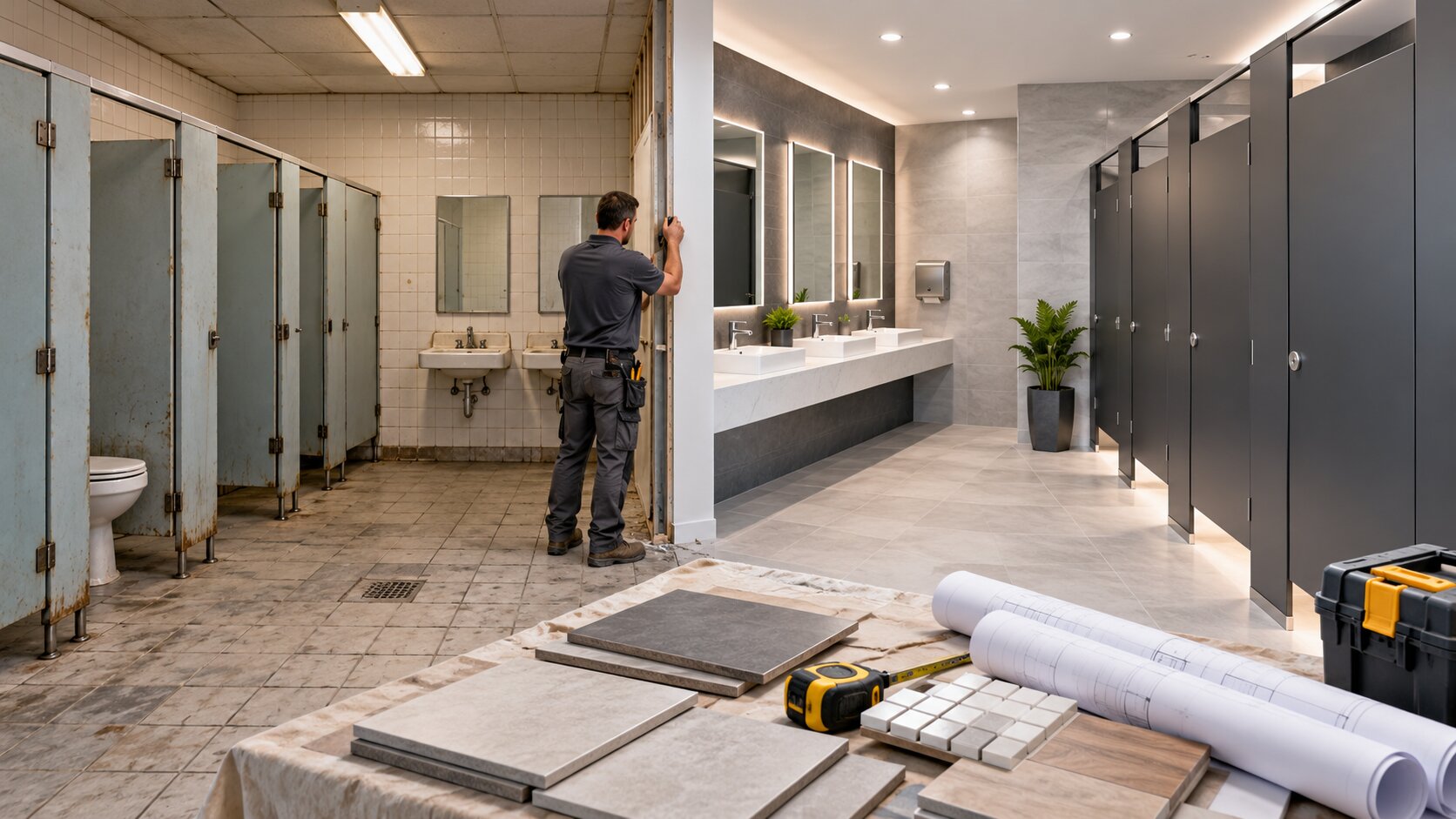
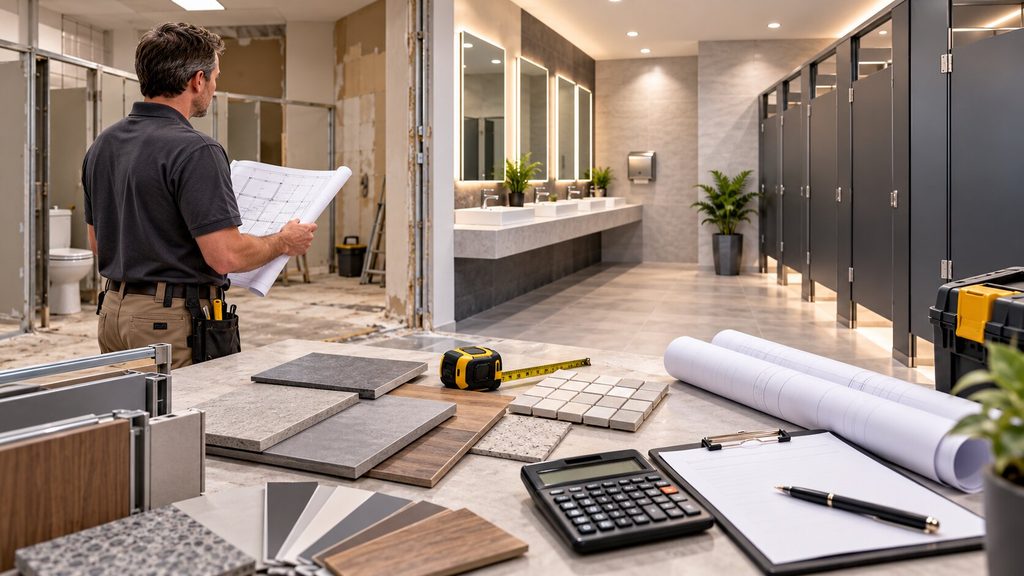
Office Toilet Refurbishment: When, Why & How Much It Costs
6 October 2026
Office toilet refurbishment is one of those projects that gets deferred year after year until it can no longer be ignored. By then — swelling cubicle panels, broken locks, stained vanity tops, users complaining — the project is more disruptive and more expensive than it needed to be. This guide covers the signs that a refurbishment is overdue, what a well-specified office toilet refurbishment should include, and what it is likely to cost.
Key takeaways
Office toilet refurbishment typically involves replacing cubicles, vanity units, IPS panels and wall surfaces. The scope depends on whether the existing services and floor are being retained.
Seven to ten years is a realistic service life for standard-specification office toilets. Correctly specified solid grade laminate cubicles should last fifteen to twenty years.
The most common reason office toilets fail early is wrong material — standard laminate on MDF in a wet environment. It looks the same as solid grade laminate when new and fails within five to eight years.
Office toilets must provide accessible provision under Approved Document M and the Equality Act 2010. If the current layout does not include a compliant accessible cubicle, a refurbishment is the right time to add one.
IPS panels behind sanitaryware are a practical upgrade at refurbishment — they replace tiling with a seamless, maintenance-free surface that is significantly easier to clean.
Whole-office occupancy is not required during a refurbishment. Phased installation keeps some provision available throughout.
When do office toilets need refurbishing?
The honest answer is: sooner than most facilities managers think. Office toilets are used constantly — every working day, by every member of staff. In a 100-person office, the toilets may see 300–400 uses a day. The materials have to perform under those conditions for years, and most office toilet installations were not specified with that in mind.
Signs a refurbishment is needed:
Cubicle panels are swelling or delaminating. The most common failure in office toilet cubicles. Once the MDF core has absorbed moisture through a cut edge or failed seal, the panel swells and cannot be restored. The door no longer hangs level, the lock no longer engages cleanly, and the visual standard of the installation deteriorates visibly.
Hardware is corroding. Chrome-plated zinc locks, hinges and overhead beams corrode in washroom humidity within two to three years. Corroded hardware is difficult to clean, looks poor and eventually seizes. Replacement hardware on existing panels is possible when panels are sound; when panels are also failing, a full refurbishment makes more sense.
The vanity top has failed sealant or visible damage. The joint between the basin rim and the vanity top is the most common failure point in office toilets. Once the sealant fails, moisture gets behind the top and into the substrate. Mould follows. A failed vanity top cannot be maintained to a hygiene standard regardless of cleaning frequency.
Cleaning is taking longer than it should. If the cleaning team is spending significantly more time on the office toilets than they were two years ago, the surfaces have degraded. Grout lines, damaged panels and failed sealant all increase cleaning time and reduce the achievable hygiene standard.
Staff are commenting. Office toilet condition is one of the most reliable proxies for how well a building is managed. When staff start commenting — formally or informally — the problem has been visible long enough to affect perception.
The accessible cubicle does not meet current standards.Approved Document M requirements have been updated over time. An accessible cubicle installed more than ten years ago may not meet current dimensions for turning circle, transfer space, door clear width or grab rail position. The Equality Act 2010 requires service providers to make reasonable adjustments — a refurbishment is the right time to bring accessible provision up to current standard.
What does an office toilet refurbishment include?
The scope of an office toilet refurbishment varies depending on the condition of the existing installation and what is being retained. A typical full refurbishment covers:
Toilet cubicles. Removal of existing cubicle panels, doors, pilasters and overhead beams; supply and installation of new office toilet cubicles in solid grade laminate with stainless steel ironmongery. Panel heights, door configuration and accessible provision confirmed and designed to the specific washroom dimensions.
IPS and duct panelling. Removal of existing wall tiling or surfaces behind toilets and washbasins; installation of IPS panel systems in solid grade laminate. IPS panels replace grout-lined tiled surfaces with a continuous, flat, seamless surface — significantly easier to clean and non-destructively accessible for maintenance.
Vanity units. Removal of existing vanity tops and unit fronts; supply and installation of new solid surface or solid grade laminate vanity tops, with integrated or undermounted basins where appropriate. The basin-to-worktop joint is sealed or eliminated — the most common maintenance failure in office toilets.
Flooring. Not always included, depending on the condition of the existing floor. Where flooring is being replaced, sheet vinyl or large-format porcelain tile is the typical specification — both are waterproof and easy to clean.
Lighting and ventilation. Not typically included in a cubicle and vanity refurbishment, but often addressed at the same time if the existing provision is inadequate. Ventilation extract rates for office toilets should meet Part F of the Building Regulations (minimum 15 litres per second intermittent).
Decoration. Ceiling, paintwork and any wall areas not covered by IPS panels or cubicle systems.
Why office toilet refurbishments fail
Most office toilet refurbishment projects that fail do so for one of three reasons.
Wrong material. Standard laminate on MDF — the most common specification at the lower end of the market — looks identical to solid grade laminate when installed. Within three to five years in a wet environment, it begins to fail. By year seven or eight, the panels are swelling, the laminate is lifting and the doors are binding. Specifying solid grade laminate at the outset adds cost, but it also adds ten years to the service life.
Split supply chain. When the surveyor is a different company from the manufacturer, which is a different company from the installer, there is no single point of accountability. Panels that do not fit are someone else’s problem. Damage during installation is disputed. BRAC Projects surveys, manufactures and installs as a single package — the same team is responsible from measurement to handover.
No site survey. Office toilet dimensions are frequently different from the drawings — particularly in older buildings. Panels cut from catalogue sizes to fit a non-standard room leave exposed cut edges. Exposed cut edges in MDF are the entry point for moisture. A site survey before manufacture is not optional; it is the step that determines whether the installation lasts.
How much does an office toilet refurbishment cost?
Cost depends on scope, ceiling height, number of cubicles, material specification and whether work is done during the working day or out of hours. A realistic range for a full office toilet refurbishment in the UK is:
Basic refurbishment (standard height cubicles, HPL panels, basic vanity) — lower end of the market. Suitable for back-of-house or low-traffic staff facilities where the brief is functional rather than presentable.
Mid-range refurbishment (solid grade laminate cubicles, IPS panels, solid grade laminate vanity) — the correct specification for a front-of-house office toilet or any washroom that represents the business to visitors. This is the specification that will last fifteen to twenty years without further investment.
Premium refurbishment (floor-to-ceiling cubicles, solid surface vanity with integrated basin, seamless splashback) — appropriate for client-facing washrooms in professional services, financial, legal or hospitality sectors where the washroom is part of the workplace experience.
The most useful benchmark is not the initial cost but the annualised cost over the service life. A basic refurbishment that needs replacing in seven years costs more per year than a mid-range refurbishment that lasts twenty.
For a specific budget, the right approach is to request a site survey and specification — the scope and cost can then be confirmed against the actual washroom rather than a general estimate.
How long does an office toilet refurbishment take?
A single-washroom office toilet refurbishment — cubicles, IPS panels and vanity — typically takes three to five days on site. Multi-floor or multi-washroom refurbishments run longer and are usually phased to maintain provision throughout.
Out-of-hours installation is common in office environments where the building is occupied Monday to Friday. BRAC Projects regularly delivers office toilet refurbishments over evenings and weekends to avoid disrupting building occupants. The programme is agreed in advance with the building manager before work begins.
Phased installation allows one bank of cubicles to remain in service while another is being refurbished. This extends the overall programme slightly but maintains washroom access throughout — particularly important in buildings without alternative provision on the same floor.
Case studies
Millennium Bridge House, London — 38 washroom areas across a multi-tenanted office building in London, refurbished while the building remained fully occupied. Executive cubicles and solid surface vanity units throughout, delivered on schedule without disrupting tenants. See the Millennium Bridge House case study.
Westbourne Terrace, Paddington — 38 washroom areas in a central London office building. Executive cubicles and solid surface vanity units. All deliveries and installation carried out without disruption to the building’s tenants and working day. See the Westbourne Terrace case study.
New Square, London — high-end shower block and changing facilities in a new-build commercial development in central London. Solid surface vanity units with bespoke cupboards and mirrored wall units. See the New Square case study.
Frequently asked questions
How often should office toilets be refurbished?
A correctly specified office toilet — solid grade laminate cubicles, stainless steel hardware, solid surface or solid grade laminate vanity — should last fifteen to twenty years before a full refurbishment is needed. Standard laminate on MDF typically needs replacing within seven to ten years. The material choice at installation determines the refurbishment cycle.
Can office toilet cubicles be replaced without a full refurbishment?
Yes. Cubicles can be replaced independently of vanity units, IPS panels and flooring, provided the existing installation is in good condition and the dimensions allow. When multiple elements are failing at the same time, a full refurbishment is usually more cost-effective than piecemeal replacement.
Do office toilets need to provide accessible facilities?
Yes. Approved Document M and the Equality Act 2010 require accessible washroom provision in commercial buildings. At minimum, one wheelchair-accessible unisex toilet should be provided at each washroom location, with specific internal dimensions, door clear width, transfer space and grab rail provision. A refurbishment is the right time to bring accessible provision up to current standard.
Can office toilet refurbishment be done while the office is occupied?
Yes. Out-of-hours and phased installation allow office toilet refurbishments to be completed without disrupting building occupants. BRAC Projects plans installation sequences around the building’s operating hours and maintains some washroom access throughout.
What is the most hygienic specification for an office toilet?
Solid grade laminate cubicle panels (no absorbent core, resistant to cleaning chemicals), IPS panels behind sanitaryware (eliminating grout lines and exposed pipework), solid surface vanity tops with integrated or undermounted basins (eliminating the basin-to-worktop joint where mould accumulates), and stainless steel hardware (does not corrode in washroom conditions).
How do I get a quote for an office toilet refurbishment?
The most accurate quote comes from a site survey — dimensions taken on site rather than from drawings, with service positions confirmed and any constraints identified. BRAC Projects carries out site surveys and provides specification and budget at no charge.
Planning an office toilet refurbishment
Office toilet refurbishment is a project where the specification decision made at the outset determines the outcome for the next fifteen to twenty years. Getting the material right, using a single supplier who surveys and installs, and specifying accessible provision to current standards are the three decisions that most affect long-term value.