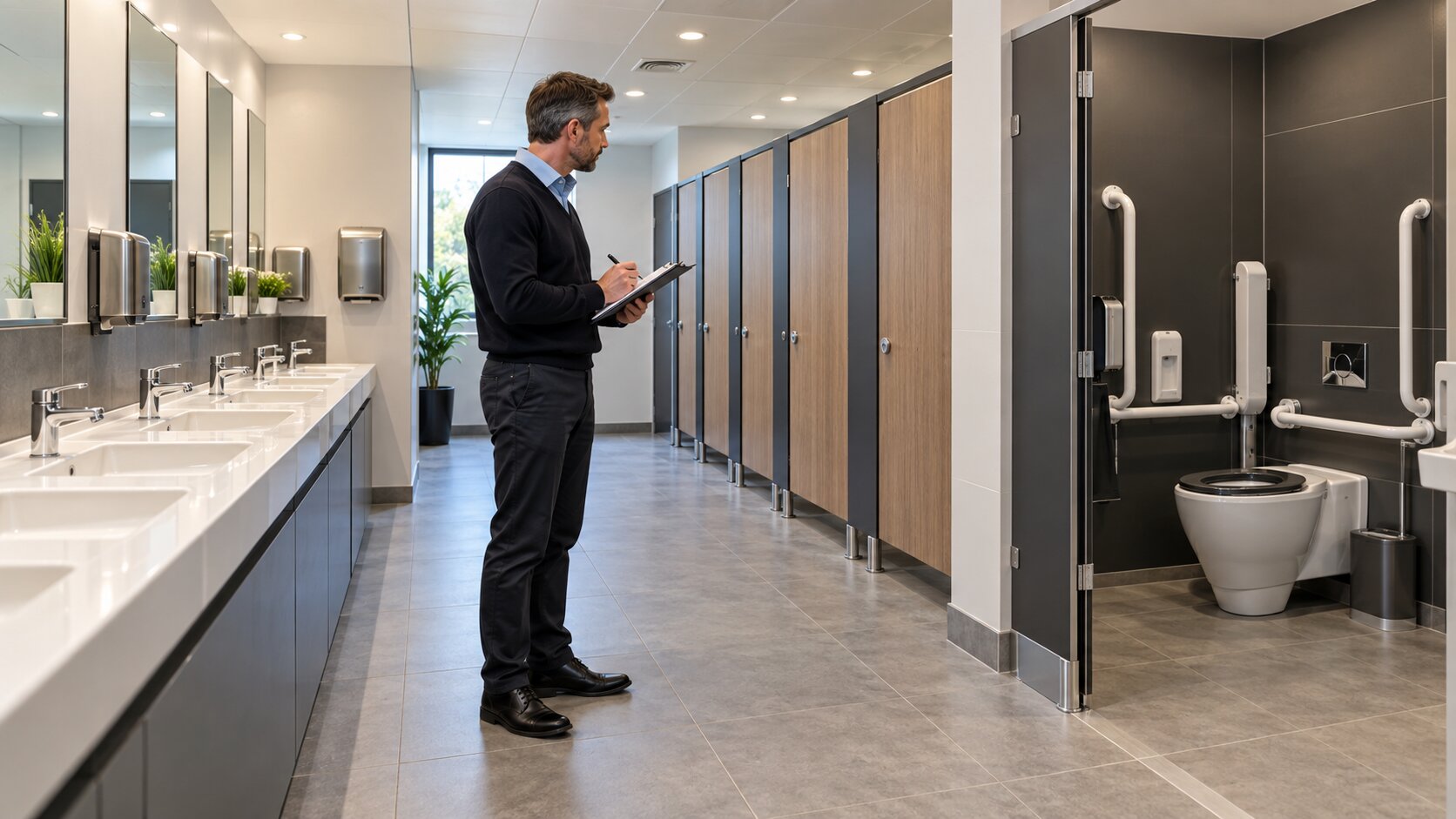
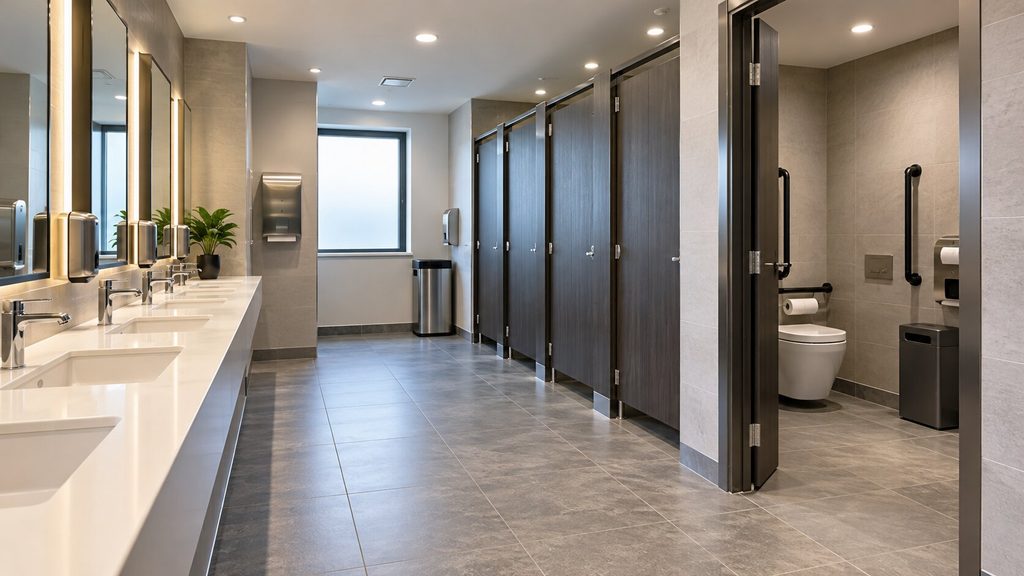
What Is the Legal Requirement for Toilets in the Workplace? UK Rules Explained
6 October 2026
Most employers know they have to provide toilets. Fewer know exactly how many, what standard they need to meet, or what the consequences are of getting it wrong. The legal requirement for toilets in the workplace in the UK is set by several overlapping regulations — and non-compliance can lead to HSE enforcement, fines and in some cases employment tribunal claims. This guide sets out what the law actually requires, in plain language.
Key takeaways
The Workplace (Health, Safety and Welfare) Regulations 1992 — specifically Regulation 20 — set the primary legal requirement for toilets in the workplace UK.
Toilet numbers are set by employee headcount — the minimum ratios are published by the HSE and differ for mixed/female facilities and male-only facilities.
Separate provision for men and women is required where reasonably practicable. Where this is not possible, individual lockable rooms used by one person at a time are permissible.
Accessible provision is required under Approved Document M and the Equality Act 2010 — at least one accessible toilet at each washroom location.
Non-compliance can result in an HSE improvement notice, fines and prosecution. Inadequate provision for one sex can also constitute direct sex discrimination under employment law.
The standard is not just “enough toilets” — facilities must be clean, properly lit, ventilated, maintained, and supplied with paper, soap and hand-drying facilities.
What law governs toilets in the workplace?
The primary legislation is the Workplace (Health, Safety and Welfare) Regulations 1992 (SI 1992/3004). Regulation 20 covers sanitary conveniences and sets out the employer’s duty to provide suitable and sufficient toilet facilities for employees.
The Regulations are supported by an Approved Code of Practice and guidance published by the Health and Safety Executive (HSE). The ACOP and guidance are not law themselves, but they set out what compliance looks like in practice, and an employer who follows them will normally be considered compliant. An employer who departs from them must be able to show they met the underlying regulation in another way.
Two further sets of regulations interact with the Workplace Regulations:
Approved Document M of the Building Regulations (with 2024 amendments) sets the requirements for accessible toilet provision — wheelchair-accessible unisex toilets, ambulant cubicles and the dimensions that make them genuinely usable. This applies on new build and on refurbishment.
The Equality Act 2010 requires employers to make reasonable adjustments to ensure that disabled employees can use washroom facilities. Inadequate provision for disabled employees is a potential disability discrimination claim, separate from any HSE enforcement.
How many toilets are required in the workplace?
The HSE sets out minimum toilet provision ratios. These differ depending on whether the facilities are for mixed use or women only, or for men only.
Mixed use or women-only facilities
Number of employees
Toilets required
1–5
1
6–25
2
26–50
3
51–75
4
76–100
5
For more than 100 employees, add one toilet for every 25 additional employees, or part thereof.
Male-only facilities (where urinals are provided)
Number of male employees
Toilets
Urinals
1–15
1
1
16–30
2
1
31–45
2
2
46–60
3
2
61–75
3
3
76–90
4
3
91–100
4
4
These are minimum ratios. In practice, many workplaces benefit from provision above the minimum — particularly where shift patterns mean peak toilet demand at specific times, or where the building has limited alternative provision nearby.
It is worth noting that these ratios relate to employees. Visitors, contractors and members of the public using the building may need to be factored in separately depending on the nature of the premises.
What must workplace toilets include?
The Workplace Regulations set requirements for the condition and equipment of toilets, not just the number. Regulation 20 and the ACOP require that workplace toilets:
Are kept clean and in good repair. This is a continuing obligation, not a one-time standard at installation. A facility that was compliant when installed but is now deteriorating may not meet the Regulation.
Are adequately ventilated. Either by opening windows or by mechanical extraction. Approved Document F sets minimum ventilation rates for toilet accommodation — 15 litres per second for an intermittent fan or 6 litres per second continuous extract.
Are adequately lit. Toilets must have sufficient lighting for safe and comfortable use. Natural lighting is preferable where possible.
Are supplied with toilet paper. This sounds basic, but the Regulation explicitly requires it.
Have a means of disposing of sanitary dressings in female toilets. A sanitary disposal unit is required in any toilet used by female employees.
Have washing facilities nearby. The Regulation requires washbasins with running hot and cold water, soap and suitable drying facilities adjacent to or in the toilet accommodation.
Are separate for men and women where reasonably practicable. Shared facilities where both sexes use the same toilet at the same time are only permissible where it is genuinely not reasonably practicable to provide separate facilities. A single-person lockable toilet room used one person at a time is not shared — it is a unisex facility, which is permissible.
What is the legal requirement for accessible toilets in the workplace?
The Workplace Regulations require that toilets are available for the use of disabled employees. Approved Document M (with 2024 amendments) and Approved Document T (effective October 2024) set the design standard.
The minimum requirement is at least one wheelchair-accessible unisex toilet at each location in the building where toilets are provided. This is not a building-wide requirement — it is a per-location requirement. An office with toilet provision on three floors should have accessible provision on each floor.
Key accessible toilet requirements under Approved Document M include:
Clear transfer space of at least 900mm to one side of the WC pan
WC seat height between 480mm and 500mm from the floor
Door clear opening width of at least 775mm
Horizontal drop-down grab rail on the transfer side
Vertical grab rail on the rear wall
Emergency pull cord accessible from the floor
Travel distance to the accessible toilet of no more than 40 metres on the same floor
The Equality Act 2010 adds a separate duty: employers must make reasonable adjustments to ensure disabled employees can access facilities. This may extend beyond the minimum Approved Document M provision in specific circumstances — for example, where a particular employee has a specific need that the standard accessible toilet does not accommodate.
What happens if an employer does not comply?
Non-compliance with the Workplace Regulations on toilet provision is enforced by the Health and Safety Executive. The enforcement route is:
Improvement notice. An HSE inspector who identifies a breach will issue an improvement notice requiring the employer to remedy the situation within a specified time period.
Prohibition notice. Where there is a risk of serious personal injury — which toilet provision deficiencies are unlikely to meet, but poor conditions theoretically could — a prohibition notice can stop the activity causing the risk.
Prosecution. Failure to comply with an improvement notice, or serious ongoing non-compliance, can result in prosecution in the magistrates’ court or Crown Court.
Fines. For conviction in a magistrates’ court, fines are unlimited. For more serious breaches in the Crown Court, fines are also unlimited and custodial sentences are possible for the most serious health and safety offences.
Separate employment law risk. Inadequate toilet provision for one sex — for example, significantly fewer toilets for women than for men — can constitute direct sex discrimination under the Equality Act 2010. Employment tribunal claims for discrimination, including injury to feelings awards, can range from £1,000 to £50,000 or more.
Gender-neutral toilet provision in the workplace
The increasing prevalence of gender-neutral toilet facilities raises a question about compliance with the Workplace Regulation requirement for separate male and female provision.
The Regulation requires separate provision “where reasonably practicable.” An individual lockable room that can be used by one person at a time — regardless of sex or gender — is not a shared facility and does not breach the separation requirement. Gender-neutral toilet provision using individual lockable cubicles, each with their own washbasin, is therefore compliant with the Workplace Regulations.
Gender-neutral provision that involves multiple users sharing the same toilet space at the same time would not comply unless it is genuinely not reasonably practicable to provide separate facilities.
What does a compliant workplace toilet look like in practice?
A workplace toilet that meets all applicable requirements will:
Provide the minimum number of toilets for the employee headcount, calculated against the HSE ratios
Be kept clean and in good repair
Be properly ventilated (mechanical extract at minimum 6 litres/second continuous or 15 litres/second intermittent)
Have adequate lighting
Be supplied with toilet paper, soap and hand-drying facilities
Include a sanitary disposal unit in any toilet used by female employees
Provide separate facilities for men and women (or individual lockable rooms)
Include at least one wheelchair-accessible unisex toilet at each washroom location, meeting Approved Document M dimensions
For an office undergoing a toilet refurbishment, a site survey and specification that confirms compliance with all these requirements before work starts is the most reliable approach. See our guide to office toilet refurbishment for a practical overview of what a compliant specification involves.
Frequently asked questions
What are the legal requirements for toilets in the workplace UK?
The primary legal requirement is set by Regulation 20 of the Workplace (Health, Safety and Welfare) Regulations 1992, supported by HSE Approved Code of Practice and guidance. Employers must provide a sufficient number of clean, well-maintained, ventilated and lit toilets with washing facilities. Minimum numbers are set by the HSE ratios (1 toilet for 1–5 employees, rising to 5 toilets for 76–100 employees for mixed or female provision). Accessible provision is required under Approved Document M and the Equality Act 2010.
How many toilets are required per employee in the UK?
For mixed or female-only facilities: 1 toilet for 1–5 employees, 2 for 6–25, 3 for 26–50, 4 for 51–75, 5 for 76–100. For male-only facilities with urinals, separate ratios apply — 1 toilet and 1 urinal for up to 15 men, scaling up from there. These are minimum ratios set by the HSE under the Workplace Regulations 1992.
Do workplace toilets need to be separate for men and women?
Yes, where reasonably practicable. Where separate facilities are not reasonably practicable, individual lockable rooms that can be used by one person at a time are permissible. Shared facilities where both sexes use the same toilet room simultaneously are only acceptable where it is genuinely not reasonably practicable to provide separate provision.
Is it a legal requirement to provide an accessible toilet in the workplace?
Yes. Approved Document M requires at least one wheelchair-accessible unisex toilet at each location in a building where toilets are provided. The Equality Act 2010 also requires employers to make reasonable adjustments to ensure disabled employees can access washroom facilities.
What happens if an employer does not provide enough toilets?
The HSE can issue an improvement notice requiring the employer to remedy the situation. Continued non-compliance can result in prosecution and unlimited fines. Inadequate provision for one sex may also constitute sex discrimination under the Equality Act 2010, with potential employment tribunal claims up to £50,000 or more for injury to feelings.
Can an employer provide gender-neutral toilets instead of separate male and female facilities?
Yes, provided each toilet is an individual lockable room used by one person at a time. This satisfies the Workplace Regulations requirement for separate provision, as no two people of different sexes are using the same toilet space simultaneously. Gender-neutral facilities with multiple users sharing a common space would not comply unless separate provision is genuinely not reasonably practicable.
Is your workplace toilet provision compliant?
The legal requirement for toilets in the workplace in the UK is clear, but many workplaces are non-compliant — either through under-provision, inadequate maintenance, or missing accessible facilities. A toilet refurbishment is the right time to check compliance across all requirements and bring the provision up to current standards.
BRAC Projects designs and installs commercial toilet cubicles and IPS panel systems for offices and commercial buildings across the UK. We can advise on compliant provision as part of the specification process. To discuss a project, get in touch.