

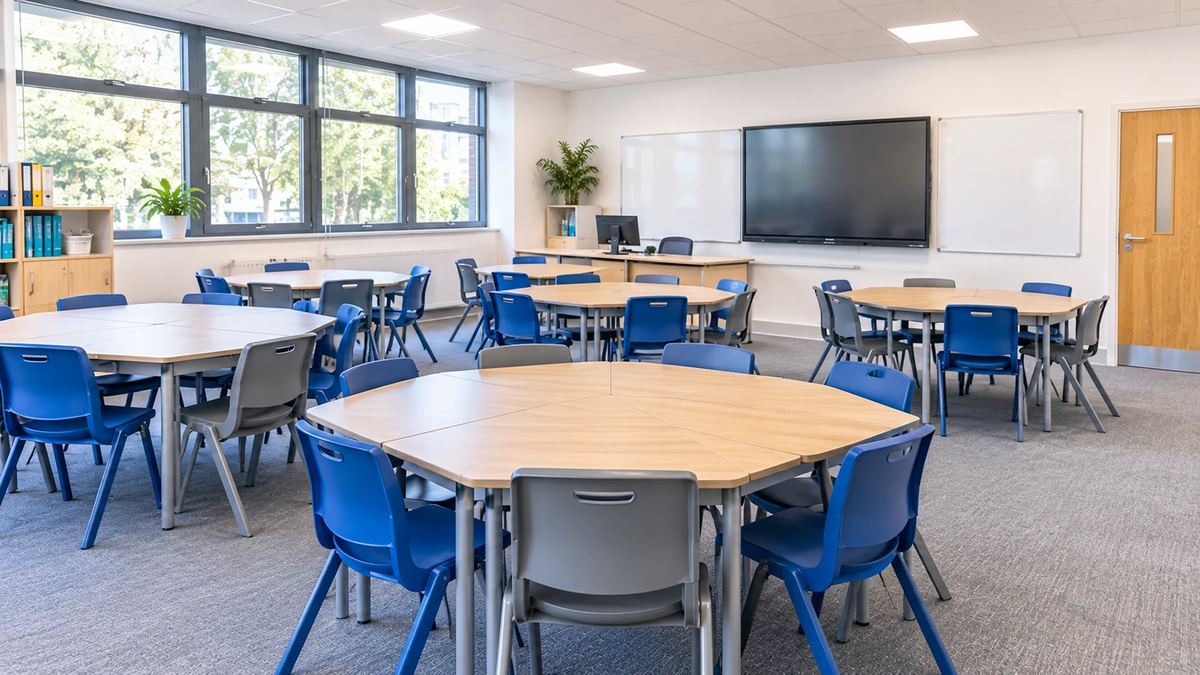
Classroom tables shape how a lesson runs. Rows suit tests and direct teaching, groups suit discussion and project work, and many classrooms now switch between the two several times a day. Choosing the right shape, size and layout makes a room easier to teach in and easier to keep tidy.
This guide compares the main shapes of classroom table, explains which layouts suit which lessons, sets out how school tables are sized under BS EN 1729, and covers what to look for in tables that will last. It is written for heads, school business managers and facilities teams planning new furniture or a refit.
Table of Contents
What are the main types of classroom tables?
The main types of classroom table are rectangular, trapezoid, round or semi-circular, and flexible or mobile tables. Rectangular tables are the most versatile, trapezoid tables join into many group shapes, round tables suit small-group work, and mobile tables suit rooms that change layout often during the day.
| Table shape | Strengths | Watch out for | Best for |
|---|---|---|---|
| Rectangular | Versatile, fits rows or blocks | Group work can feel formal | Most classrooms |
| Trapezoid | Joins into hexagons and curves | Needs more floor space in groups | Group work and flexible layouts |
| Round or semi-circular | Everyone faces each other | Harder to put in rows | Small groups, early years, libraries |
| Flexible or mobile | Quick to rearrange | Castors must lock firmly | Rooms used for different activities |
Which classroom layout works best?
No single classroom layout works best for every lesson. Rows suit tests and teacher-led input, grouped tables suit collaboration, a horseshoe suits whole-class discussion, and flexible zones suit rooms used for different activities. Many schools choose tables that can move between these layouts quickly.
Rows
Rows give every pupil a clear view of the board and suit assessments, but make group work harder.
Groups or clusters
Tables pushed together for four to six pupils support discussion and shared tasks, and are common in primary schools.
Horseshoe
Tables in a U-shape let everyone see the teacher and each other, which suits discussion-led lessons and smaller classes.
Flexible zones
Different areas of the room are set up for different activities, often with mobile tables and a quiet corner.
What size should classroom tables be?
Classroom tables should be sized to the pupils who use them. In the UK, school chairs and tables are sized using size marks under BS EN 1729, which are based on pupils’ height rather than their age. Part 1 (2015) sets functional dimensions and Part 2 sets safety requirements and test methods.
The standard replaced the older British standard BS 5873, and tables and chairs with the same size mark are designed to be used together. Because children in the same year group vary in height, many classrooms need more than one size. Local authority guidance, such as Rotherham Council’s guide to furniture standards, sets out how to measure pupils and choose sizes.
Our school furniture buying guide explains sizing for primary and secondary schools in more detail.
How much space do classroom tables need?
Classroom tables need enough space around them for pupils to move safely, for the teacher to reach every table, and for clear routes to the door. In England, the Department for Education’s Building Bulletin 103 area guidelines (2014) set non-statutory space guidelines for school buildings for ages 3 to 19, and room sizes limit which layouts will fit.
Grouped layouts and horseshoes usually need more floor space than rows. Before choosing tables, measure the room and sketch the layouts you want to use, including the teacher’s desk, storage and any wheelchair-accessible positions.
What should classroom tables be made from?
Classroom tables should have a hard-wearing, easy-clean top and a strong, stable frame. High-pressure laminate tops are common because they resist scratches and are easy to wipe down, while steel frames give stability. Edges should be rounded or protected so they resist chipping and are safe for pupils.
- High-pressure laminate or compact laminate tops for durability
- Steel frames for strength and stability
- Protected or rounded edges that resist chipping
- Adjustable feet so tables sit level on uneven floors
- Lockable castors on mobile tables
What are common mistakes when buying classroom tables?
Common mistakes when buying tables include buying one size for a whole year group, choosing shapes that do not suit how the room is taught, and picking cheap tops that chip within a year or two. Each of these makes the room harder to use and costs more to fix later.
- Buying a single size for every pupil
- Choosing tables before measuring the room
- Ignoring how teachers actually use the space
- Choosing tops and edges that chip easily
How do classroom tables work with the rest of the room?
Classroom tables work best when the room is planned as a whole: clear sightlines to the board, storage that keeps resources off the tables, and space to move around. A teaching wall can free up floor space by moving storage to the front of the room.
For a full refit, see our guide to classroom renovations, our range of school desks and our guide to school library furniture.
Frequently asked questions
What is the best shape for classroom tables?
Rectangular tables are the most versatile because they work in rows or groups. Trapezoid tables are popular for group work because they join into hexagons and curves. The best shape depends on how the room is taught, so many schools mix shapes or choose tables that can be rearranged quickly.
How many pupils should sit at a classroom table?
It depends on the table size and the activity. Grouped layouts commonly seat four to six pupils so they can work together, while individual or paired tables suit tests and focused work. Make sure every pupil can still see the board from their seat.
What size classroom tables do children need?
Classroom tables are sized using size marks under BS EN 1729, based on pupils’ height rather than their age. Tables and chairs of the same size mark are designed to work together, and many classrooms need more than one size because children in the same year vary in height.
Are mobile classroom tables a good idea?
Mobile tables suit rooms that change layout often, because they can be moved quickly between rows, groups and open space. Choose tables with lockable castors so they stay stable during lessons, and check that the frame is strong enough for daily use.
What is the most durable classroom table top?
High-pressure laminate is a durable, easy-clean choice for most classrooms. Compact laminate is tougher still because it is solid throughout and waterproof, which suits heavy-use or wet areas such as art rooms. Protected edges help both last longer. Ask for samples so you can compare finishes and colours before ordering.
Do you make bespoke classroom furniture?
Yes. BRAC Projects designs and manufactures bespoke classroom furniture, including teaching walls and storage, at our workshop in Polegate, East Sussex, and installs it in schools across the UK, including work for Northwood School. Each project is designed around the room and the way it is taught.
Choosing classroom tables
The right tables match the way each room is taught, are sized to the pupils under BS EN 1729, and are built to last. Planning tables alongside storage, the teaching wall and the room’s space guidelines gives a classroom that is easy to rearrange and easy to teach in.
See our educational furniture service and our education sector work.
Planning new classroom furniture? Tell us about your rooms and teaching style and we will suggest furniture and layouts that fit. Contact us for a free, no-obligation quote.