

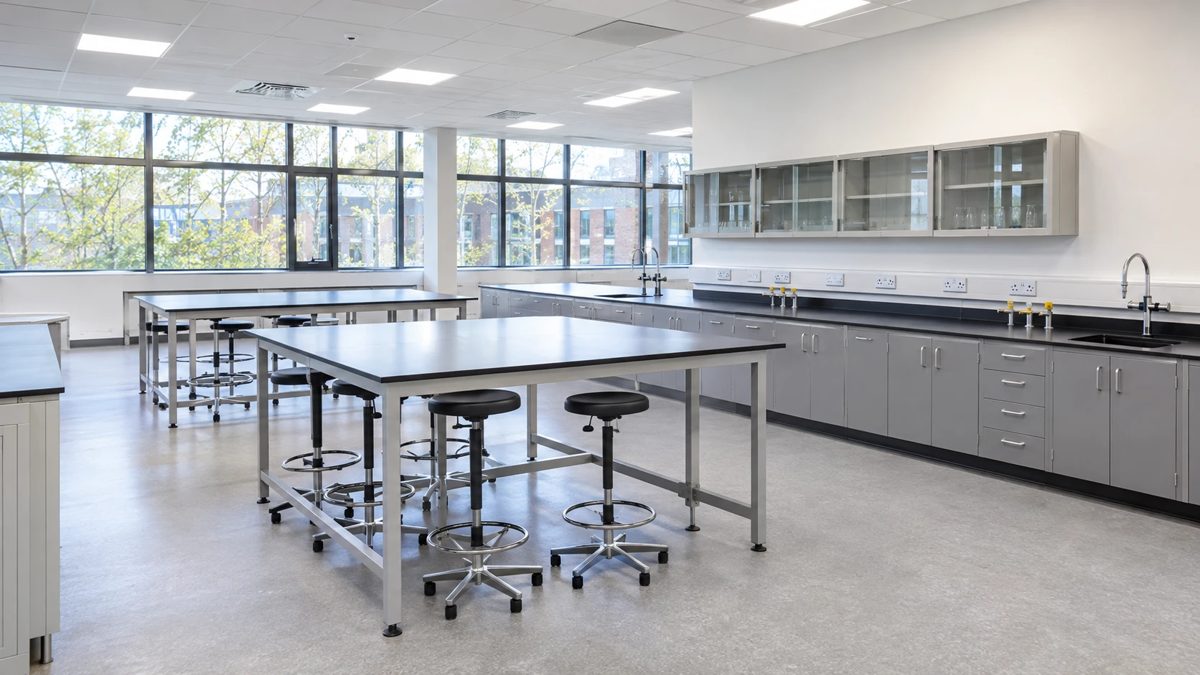
Lab benches and lab tables look similar, and the terms are often used as if they mean the same thing. They don’t. Choosing the wrong one can leave a laboratory without the services, strength or flexibility it needs, and it is expensive to change once the room is fitted out.
This guide explains the difference between a lab bench and a lab table, where each one works best, and how to decide what your school, college, university or research laboratory needs.
Table of Contents
What is a lab bench?
A lab bench is a fixed, heavy-duty work surface built for practical laboratory work. It is usually fixed to the floor or wall and fitted with services such as gas, water, power and data, plus storage underneath. A lab bench is designed to stay in place and carry equipment, heat and chemical spills every day.
Benches are the backbone of most laboratories. In a school science lab they hold the gas taps and sinks pupils use for practicals. In a research lab they hold instruments, fume extraction points and specialist services.
BRAC Projects designs and manufactures bespoke laboratory benching at our workshop in Polegate, East Sussex, so each bench is built to the room rather than chosen from a catalogue.
What is a lab table?
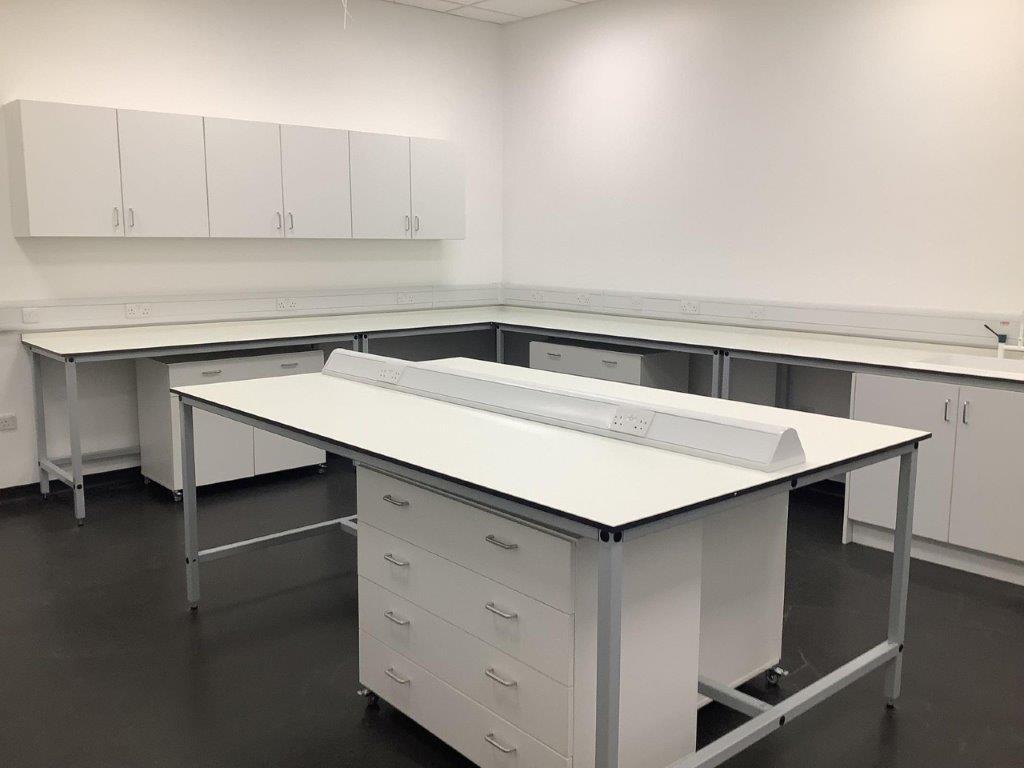
A lab table is a free-standing work surface on legs or a frame, usually without built-in services. It can be moved, rearranged or added to as needs change. Lab tables suit write-up areas, dry work, teaching zones and flexible spaces where the layout changes during the year.
Many tables still use chemical-resistant tops, so they can cope with light practical work. Some have castors so they can be moved between lessons or experiments, and some are height-adjustable for accessibility.
What is the difference between a lab bench and a lab table?
The main difference between a lab bench and a lab table is that a bench is fixed and serviced, while a table is free-standing and usually unserviced. Benches carry gas, water and power for practical work. Tables give flexible space for writing, dry work and changing layouts.
| Feature | Lab bench | Lab table |
|---|---|---|
| Position | Fixed to floor or wall | Free-standing, often movable |
| Services | Gas, water, power and data built in | Usually none, or power only |
| Strength | Heavy-duty frame or carcass, high load capacity | Lighter frame, lower load capacity |
| Storage | Cupboards and drawers built underneath | Usually open underneath |
| Flexibility | Layout set at installation | Can be moved and reconfigured |
| Typical use | Wet practicals, instruments, sinks | Write-up, dry work, teaching, overflow space |
| Cost | Higher, because of services and installation | Lower |
When should you choose a lab bench?
Choose a lab bench when the work needs services, heavy equipment or wet chemistry. Benches suit practical science lessons, research work with instruments, and any area with sinks, gas taps or fume extraction. They also suit spaces where safety depends on a fixed, stable surface.
- Wet chemistry and practical science lessons
- Rooms with gas taps, sinks or wash-up areas
- Heavy or sensitive instruments that must not move
- Areas where services are run through the furniture
- Labs that need lockable storage under the worktop
When should you choose a lab table?
Choose a lab table when the space needs to change often, or when the work does not need services. Tables suit write-up areas, theory teaching in a lab, dry practical work, and flexible research spaces. They are also useful for adding extra working space without fitting new services.
- Write-up and theory areas inside the lab
- Dry practical work such as physics or electronics
- Flexible spaces used for different subjects
- Overflow space during busy practical sessions
- Height-adjustable positions for accessible working
Can a lab use both benches and tables?
Yes. Many labs combine both: fixed, serviced benches around the perimeter or in islands for practical work, with tables in the middle for theory and write-up. This gives pupils or researchers services where they need them and flexible space everywhere else, without paying to service every position.
This mixed layout is common in schools. Our guide to school science lab design explains the main layouts and how to choose between them.
What worktop should a lab bench or table have?
The worktop depends on the chemicals, heat and cleaning it will face. Solid surface, epoxy resin and phenolic resin are common for chemistry and research labs, while high-quality laminate often suits general teaching labs and write-up tables. Benches and tables in the same room usually share one worktop material.
Compare the options in our guides to school laboratory countertops and solid surface vs laminate worktops.
How do you choose the right lab bench or table?
Start with the work the room will do, then plan services, layout and materials around it. A site survey and a short brief from the people who use the lab will show where services are needed and where flexible tables make more sense.
1. List the activities
Write down what happens in the room: wet practicals, instrument work, teaching, write-up or storage.
2. Map the services
Record where gas, water, drainage, power and data already run, and where new services are needed.
3. Decide fixed versus flexible
Put benches where services and heavy equipment are needed, and tables where the layout needs to change.
4. Choose materials and heights
Pick worktops for the chemicals used, and include at least one accessible position.
See how this works in practice in our Science Creates laboratory fit-out in Bristol, or read about our laboratory and research work.
Frequently asked questions
Is a lab bench the same as a lab table?
No. A lab bench is usually fixed and fitted with services such as gas, water and power, while a lab table is free-standing and usually has no services. Benches are built for practical work and heavy equipment; tables are built for flexible, dry or write-up work.
What is lab benching?
Lab benching is a run of connected laboratory benches, usually fixed in place, with worktops, storage and services built in. It can be arranged around the walls, as islands or as peninsulas, and is designed to suit the layout and services of a specific room.
Can lab benches be moved?
Most lab benches are fixed because they carry services such as gas, water and drainage. Some systems use a frame with service spines or bollards so benches can be reconfigured later, but moving them usually needs a fitter. Lab tables are the better choice if you need to move furniture often.
Do lab tables need chemical-resistant tops?
It depends on how they are used. Tables used only for writing and theory can use standard laminate, while tables used for practical work should have a chemical-resistant top such as solid surface, epoxy resin or phenolic resin.
Are lab benches more expensive than lab tables?
Generally yes. Lab benches cost more because of their stronger construction, built-in storage and the work needed to connect gas, water and power. Lab tables cost less because they are free-standing and usually have no services to connect.
Who makes bespoke lab benches in the UK?
BRAC Projects designs and manufactures bespoke lab benches and tables at its workshop in Polegate, East Sussex, and installs them in schools, colleges, universities and research labs across the UK.
Choosing between a lab bench and a lab table
Use lab benches where the work needs services, heavy equipment or wet chemistry, and lab tables where the space needs to stay flexible. Most labs work best with a mix of both, planned around the activities and services in the room.
Explore our educational furniture for school labs, or our guide to modular science labs.
Planning new lab benching? Send us your room layout and we will advise on benches, tables, services and worktops. Contact us for a free, no-obligation quote.