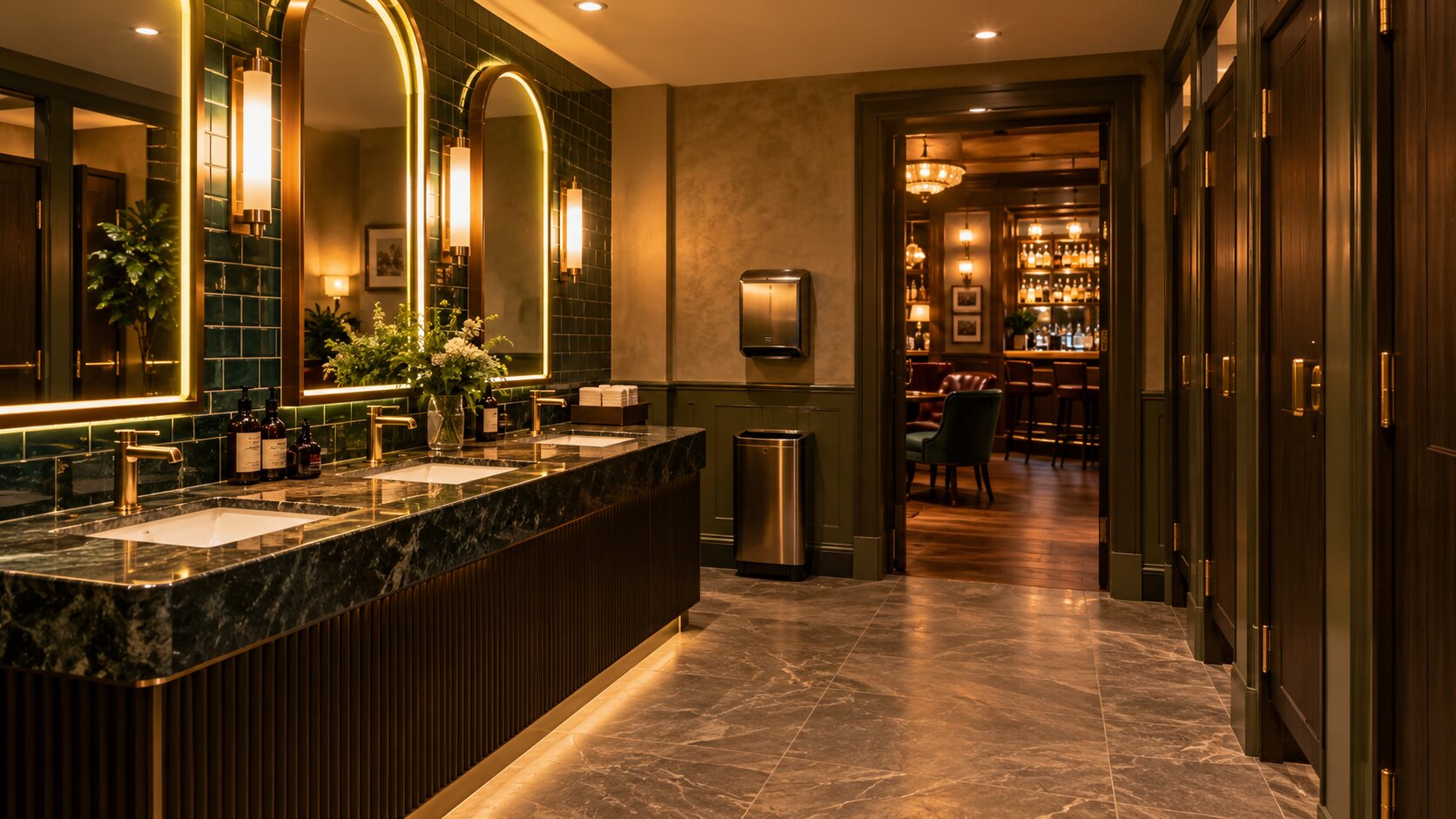
Pub toilets are rarely the reason someone walks in, but they are often the reason someone does not come back. A good pint and a warm welcome count for little if the washroom is dirty, broken or hard to find. This guide covers what customers actually complain about, what it costs a pub when the toilets let it down, and how to specify pub washrooms that stay presentable under Friday-night pressure.
Key takeaways
- Pub toilets are a repeat-custom issue, not just a hygiene issue. In a YouGov survey of 2,012 British adults for Cannon Hygiene, over 97% said poor toilets would stop them returning to a restaurant or bar, and 85% would warn friends and family off.
- A survey by laminate manufacturer Formica Group found about four in ten people rated pub and bar toilets among the worst in Britain, behind only trains.
- Customers complain about cleanliness, missing tissue and soap, and smells far more than about decor. Durable, easy-to-clean surfaces fix the root of most of these.
- Pubs need to be designed around peak demand, not average demand. Queues at 9pm on a Saturday shape the whole venue’s reputation.
- Solid Grade Laminate cubicles, full-height partitions and concealed pipework resist the knocks, spills and graffiti that wear out standard fittings.
Why do pub toilets matter for repeat custom?
Pub toilets matter because a bad experience in the washroom is remembered, repeated and shared. People rarely complain to staff about a dirty toilet. They simply do not return, and they tell the people they were with.
The numbers are consistent. The Cannon Hygiene and YouGov research, published in January 2018, found that over 97% of respondents said poor toilet standards would stop them going back to a restaurant or bar, and 85% would warn friends and family about it. Women were more likely to pass on a warning (88%) than men (81%). The survey was commissioned by a hygiene supplier, so treat the headline figure as an indicator of attitude rather than a prediction of lost sales. The direction is clear all the same.
Pubs also start from a weaker position. In the Formica Group survey, roughly four in ten respondents named pub and bar toilets among the worst in Britain. Formica makes laminate, so it has an interest in the subject, and the sample size and date were not published, but the finding matches what most operators hear from customers.
What do customers actually complain about?
Customers complain about basics: cleanliness, supplies and smell. According to the YouGov research, the top washroom complaints were:
- Unclean facilities: 90%
- No toilet tissue: 89%
- No soap: 70%
- Bad smells: 63%
Formica’s research points the same way. Cleanliness was the most important factor for 76% of respondents, and two-thirds said they regularly avoid toilets that look dirty. When asked what improvements they wanted, hands-free flushing came first (60%), followed by soundproofing (32%).
Notice what is missing from that list. Nobody is asking for marble. They want a washroom that looks clean, smells clean and works. That is good news for a pub, because the fixes are practical and the money goes into surfaces and layout, not decoration.
Why are pub washrooms so hard to keep clean?
Pub washrooms are hard to keep clean because they take more abuse in a few hours than most commercial toilets take in a week. Several pressures stack up on a busy evening:
- Peak load. Most of a night’s visits arrive in short bursts, such as after a match, at last orders or when the kitchen closes.
- Alcohol. Spills, misjudged aim and the occasional accident mean floors and partitions get wet more often than in an office.
- Rough handling. Doors are slammed, locks are forced and panels are kicked.
- Graffiti and stickers. Some surfaces are easier to mark and harder to clean than others.
- Limited cleaning time. Staff check the toilets between serving customers, so surfaces must wipe clean quickly.
This is why a washroom specified like an office toilet struggles in a pub. Standard laminate on a chipboard core swells when moisture reaches the edge, and once it swells it cannot be repaired. Our guide to when to replace commercial toilet cubicles lists the warning signs, and many of them show up in pubs first.
What should pub toilets be made from?
The best material for pub toilet cubicles is Solid Grade Laminate (SGL). It is solid colour all the way through, fully waterproof and impact resistant, and it wipes clean in seconds. There is no core to absorb water and no veneer to peel, so it holds up to spills and heavy cleaning.
Material Strength Weakness Suits Solid Grade Laminate Waterproof, tough, easy to wipe clean Higher initial cost than MFC Busy pubs, bars, venues with heavy use Standard laminate / MFC Lowest initial cost Swells when moisture reaches the core Dry, low-traffic back-of-house areas only Stainless steel Very robust Shows fingerprints, can feel cold Very high-abuse or custodial settings Our guide to compact laminate toilet cubicles explains the material in more detail. For vanity tops, the comparison of solid surface vs laminate worktops is a useful read.
Hardware is the other weak point. Cheap hinges and locks fail first in a pub. Read our guides to toilet cubicle hinges and toilet cubicle locks before you specify.
Why do full-height cubicles suit pubs?
Full-height cubicles suit pubs because they remove the gaps that cause complaints. With floor-to-ceiling panels and doors, there is no gap at the bottom to look through, no gap at the top for noise to escape and nothing to climb. Privacy improves, which customers notice, and soundproofing is among the improvements people say they want most.
Full-height systems are also easier to keep clean. With no floor gap, there is less ledge for litter to hide behind, and panels that do not touch the floor stay away from standing water. Our guide to full height toilet cubicles compares them with standard systems, and it is worth reading if you are weighing the cost.
How should a pub plan its washroom layout?
A pub should plan its washroom layout around its busiest hour, not its average one. A layout that works at 3pm on a Tuesday can fall apart at 10pm on a Saturday.
- Plan for the peak. Count your realistic capacity, not your quiet-night footfall, and size provision against it. Scales of provision for licensed premises are set out in BS 6465-1, and your licensing and building control teams will expect them to be considered.
- Keep queues out of the bar. Position the entrance so people waiting do not block the route to the bar or the fire exit.
- Separate the wet and dry zones. Basins and dryers on one side, cubicles on the other, so no one has to squeeze past wet floors.
- Include an accessible toilet. Your customers include wheelchair users and people with limited mobility, and you have duties under the Equality Act 2010. Our guide to public toilet design sets out the dimensions.
- Offer fully enclosed provision where space allows. Self-contained unisex toilets are easier to keep clean and are popular with customers.
- Hide the plumbing. Concealing pipework and cisterns behind IPS and duct panelling removes the dusty, graffiti-prone clutter, and gives maintenance access without taking the room out of use.
For more on planning numbers and circulation, our commercial toilet design guide walks through the steps.
What small details make a pub washroom feel looked after?
Small details signal care, and customers notice them. The cost is low compared with a full refit.
- Hands-free flushing and taps, which respond to the most-wanted improvement in Formica’s research.
- Reliable stock. Missing soap and tissue appear in the top complaints, so build a restock check into every round of the toilets.
- Good lighting. Bright, even light makes a room look cleaner and helps staff spot problems.
- Clear signage and a lock indicator that shows when a cubicle is free.
- Ventilation that works. Smell is a top-four complaint, so check extract fans and make sure access to ducts is easy.
- A visible cleaning log. It reassures customers and keeps the team accountable.
When should a pub refurbish its toilets?
A pub should refurbish its toilets when the fabric is failing, the layout cannot cope with demand or complaints keep returning. Warning signs include swollen or peeling panels, doors that no longer close, locks that have been forced, persistent smells and repeated queues at peak times.
The timing matters too. A washroom refit is a short job when the work is planned. Off-site manufacture and a single supplier for survey, fabrication and installation keep the pub trading and the disruption small. Our guide to office toilet refurbishment covers the process and costs in detail, and the same principles apply to a pub.
BRAC Projects has delivered washrooms for high-footfall leisure venues, including the American Express Stadium and Lewes Gym. You can read more in our leisure sector page.
Planning your pub toilet project
Pub toilets shape how customers remember a visit. Durable materials, full-height privacy, concealed services and a layout built for the peak hour keep washrooms looking cared for and protect repeat custom. To discuss a scheme, explore our washrooms and toilet cubicles service, browse recent case studies or get in touch with your drawings.
Frequently asked questions
How many toilets does a pub need?
It depends on capacity, the split of male and female customers and whether urinals are provided. Scales of provision for licensed premises are set out in BS 6465-1, and licensing and building control teams will expect them to be considered. Plan around peak capacity, not average trade.
Do pubs have to have an accessible toilet?
Pubs have duties under the Equality Act 2010 to make reasonable adjustments, and new buildings must meet Approved Document M. In practice, a wheelchair-accessible unisex toilet is expected in most premises. Check requirements with your local authority.
What is the best material for pub toilet cubicles?
Solid Grade Laminate is usually the best choice. It is fully waterproof, coloured through the core and tough enough to survive knocks and heavy cleaning, so it will not swell like standard laminate or MFC.
Are full-height cubicles worth the extra cost in a pub?
Often yes. They improve privacy and soundproofing, remove the gaps that collect litter and make cleaning faster. In a busy venue, that usually outweighs the higher upfront cost.
How often should pub toilets be checked?
Frequently during trading hours, with a logged check at regular intervals. Missing soap, missing tissue and smells are among the most common complaints, and a short routine catches all three.
How long does a pub toilet refurbishment take?
It depends on the size of the scheme and the services involved. Making the cubicles off-site and using one team for survey, manufacture and installation keeps time on site short. Send us your drawings and we will give you a programme with the quote.
Pub & Bar Washrooms: Why Toilets Matter More Than You Think for Repeat Custom