

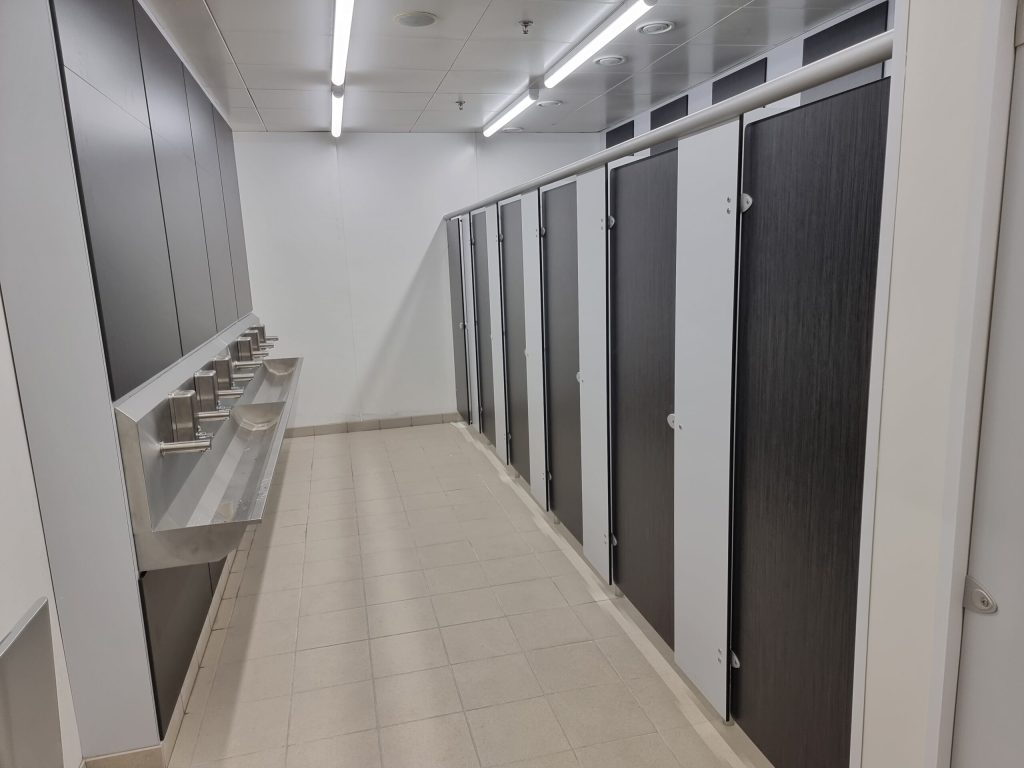
Compact laminate toilet cubicles are the standard specification for commercial washrooms where durability, hygiene and long service life matter. They look similar to standard laminate cubicles when new. The difference is what is inside — and what happens over time. This guide explains what compact laminate is, why it outperforms standard laminate in high-traffic environments, and what to look for when specifying compact laminate cubicles for a commercial project.
Key takeaways
- Compact laminate is a solid-through material — layers of resin-impregnated paper compressed into a dense panel with no separate core. It is the same material from face to edge.
- Standard laminate bonds a decorative layer to an MDF or chipboard core. The core is absorbent. In a wet environment, moisture reaches the core through cut edges and drilled holes, causing swelling and failure.
- Compact laminate toilet cubicles are fully waterproof throughout — there is no substrate to absorb moisture, regardless of where it enters.
- Service life for compact laminate cubicles in a commercial washroom is typically fifteen to twenty years. Standard laminate fails in five to eight.
- The cost difference at point of installation is recovered within a few years through avoided maintenance and replacement.
- Compact laminate is available in a wide range of colours and finishes, including through-colour (the edge matches the face) — a design advantage over standard laminate which always shows a dark core line.
What is compact laminate?
Compact laminate — also called solid grade laminate (SGL) or high-density compact laminate — is manufactured by stacking layers of kraft paper saturated with phenolic resin and pressing them under high heat and pressure into a solid, dense panel. The result is a material that is the same composition throughout: there is no decorative layer sitting on top of a separate substrate, and there is no separate core.
This construction is formally recognised in British Standard BS EN 438-4:2016, which covers compact laminates 2mm and thicker intended for interior use and describes their properties: resistance to wear, impact, scratching, moisture, heat and staining, with good hygienic properties.
The most common panel thickness for toilet cubicles is 12–13mm for standard commercial applications and 20–21mm for higher-specification or more demanding environments. Both thicknesses share the same solid-through construction.
Why compact laminate outperforms standard laminate in washrooms
The performance gap between compact laminate and standard laminate in a wet environment is straightforward to understand once you know the construction difference.
Standard laminate bonds a decorative melamine layer to an MDF or chipboard core. The core is the weak point. In a dry environment, the core is protected by the face and edges. In a washroom, moisture finds its way in through:
- Cut edges at sink cut-outs and drilled holes for fixings
- Gaps in edge banding that opens as the material moves
- Failed sealant at floor junctions and wall joints
- Worn grooves at floor level from foot traffic
Once moisture reaches the MDF or chipboard core, swelling begins. The process is irreversible — the core continues to expand, the face laminate lifts away, and the panel distorts. Within three to seven years in a commercial washroom, a standard laminate cubicle will show visible swelling, lifting laminate and distortion that prevents the door from hanging correctly.
Compact laminate has no separate core. A cut edge at a sink cut-out is the same dense, resin-saturated material as the face. A drilled hole for a hinge fixing goes through the same solid material. Moisture that gets into any of these locations cannot cause swelling because there is no absorbent substrate to swell.
This is why compact laminate is the standard specification for commercial toilet cubicles in any environment where the panels will be exposed to moisture.
Compact laminate vs standard laminate: comparison
| Compact laminate cubicles | Standard laminate cubicles | |
|---|---|---|
| Construction | Solid throughout, no separate core | Decorative layer on MDF/chipboard core |
| Standard | BS EN 438-4 | BS EN 438-3 |
| Waterproof? | Yes — fully waterproof at any cut edge | No — core absorbs moisture at edges |
| Typical service life (washroom) | 15–20 years | 3–7 years |
| Impact resistance | Very high | Moderate |
| Edge appearance | Through-colour (edge matches face) | Dark core line visible |
| Repairable? | No — replace when damaged | No — replace when damaged |
| Suitable for wet areas? | Yes | No |
| Cost | Higher initial cost | Lower initial cost |
| Whole-life cost | Lower | Higher (replacement cycle) |
Where compact laminate toilet cubicles are specified
Compact laminate cubicles are appropriate wherever the washroom will be exposed to moisture, cleaning chemicals, or heavy daily use. In practice, this covers almost all commercial washroom applications.
Schools. School washrooms are among the most demanding environments for cubicle panels — high traffic, frequent wet use, regular cleaning with commercial products. Compact laminate is the correct specification for primary and secondary school toilet cubicles. For primary schools, cubicle heights are often reduced and colourful finishes are available — the solid-through construction of compact laminate allows any colour to be specified without a visible dark core line.
See our work at Polegate Primary School — four washroom areas refurbished with compact laminate cubicles, vanity units and IPS duct sets, completed around school hours and on budget — and North Lancing School where Polyrey solid grade laminate was specified alongside Durasein solid surface wash troughs.
Leisure facilities and gyms. Changing rooms and washrooms in gyms and leisure centres are among the wettest commercial environments outside of industrial applications. Steam from showers, condensation, constant wet foot traffic — these conditions make standard laminate panels fail faster than almost anywhere else. Compact laminate is the only appropriate panel material for these environments. See our work at Lewes Gym — solid grade laminate from the Polyrey range, floor-to-ceiling cubicles with satin anodised framework.
Offices and commercial buildings. Office washrooms serve large numbers of people daily and are expected to maintain a professional appearance over years. The cleaning regimes in commercial buildings — often using concentrated products — are hard on standard laminate. Compact laminate cubicles maintain their appearance and structural integrity throughout. See our Westbourne Terrace case study — 38 washroom areas refurbished in a fully occupied London office building.
Healthcare and public buildings. Clinical cleaning in NHS environments uses high-concentration disinfectants that degrade standard laminate rapidly. Compact laminate resists these chemicals and maintains its surface integrity. For more on material specification in clinical washrooms, see our hospital fixtures and fittings guide.
Custodial and secure environments. Compact laminate in custodial settings is specified for its physical durability as well as its hygiene properties — it resists deliberate impact damage better than standard laminate. In custodial environments, anti-ligature hardware and secure fixing methods are specified alongside the panel material. See our IRC Heathrow case study.
What to look for when specifying compact laminate cubicles
Panel thickness. 12–13mm is the standard for most commercial applications. 20–21mm is specified for more demanding environments — high-traffic public facilities, sports and leisure changing rooms, custodial settings — where greater panel rigidity and impact resistance are needed.
Through-colour vs wood grain. Compact laminate in plain colours is solid-through — the edge matches the face, with no dark core line. Wood grain and textured finishes may use a different construction where the decorative surface is applied to a compact laminate core. Check with your supplier which construction applies to the finish you have selected.
Hardware specification. Panel material and hardware life should be matched. Stainless steel ironmongery (hinges, locks, overhead beams) has a service life comparable to compact laminate panels — fifteen to twenty years in a commercial washroom. Chrome-plated zinc corrodes in washroom conditions within two to three years, regardless of panel quality. See our guide to toilet cubicle locks and toilet cubicle hinges.
Bespoke vs catalogue dimensions. Compact laminate panels can be manufactured to any dimension. Where a washroom does not fit catalogue sizes, bespoke manufacture produces a clean installation without exposed cut edges or gaps. BRAC Projects manufactures all compact laminate cubicles in our UK facility to project-specific dimensions.
IPS panelling. Compact laminate panels behind toilets and urinals — IPS and duct panelling — are manufactured in the same material and provide a consistent finish across the washroom. See our IPS and duct panelling service.
Frequently asked questions
What is the difference between compact laminate and solid grade laminate?
The terms are interchangeable. Both refer to high-pressure laminate panels that are solid throughout with no separate substrate, covered by BS EN 438-4. In UK commercial washroom specification, “solid grade laminate” is the more commonly used term for cubicle panels; “compact laminate” is used more broadly across worktops, desks and locker applications. The material is the same.
How long do compact laminate toilet cubicles last?
In a commercial washroom environment, correctly installed compact laminate cubicles should last fifteen to twenty years. The limiting factor is usually the hardware — hinges and locks in chrome-plated zinc will need replacing before the panels do. Stainless steel hardware specified from the outset avoids this.
Can compact laminate cubicles be repaired?
No — unlike solid surface, compact laminate cannot be repaired in place once the surface is damaged. Damaged panels need to be replaced. In practice, compact laminate is sufficiently impact-resistant that surface damage from normal commercial use is rare. The material does not fail gradually; it either performs or it is damaged.
Is compact laminate suitable for school toilet cubicles?
Yes — it is the correct specification. School washrooms combine high traffic, wet conditions and frequent cleaning with commercial products. Standard laminate on MDF fails in these conditions. Compact laminate maintains its structural integrity and hygienic surface throughout its service life.
What colours are available for compact laminate cubicles?
Compact laminate is available in a wide range of plain colours, wood grains, stone effects and textured finishes. Plain colour panels are solid-through — the colour goes all the way from face to edge, with no dark core line. Custom RAL colours are available from some suppliers for projects where brand colour matching is required.
What is the standard thickness for compact laminate toilet cubicles?
The most common panel thickness for commercial toilet cubicles is 12–13mm. Heavier-duty applications — leisure facilities, public buildings with high footfall, custodial environments — are often specified at 20–21mm for greater rigidity and impact resistance. Hardware (hinges, locks) must be matched to the panel thickness.
Specifying compact laminate toilet cubicles
Compact laminate toilet cubicles are the correct default specification for any commercial washroom where panels will be exposed to moisture or regular cleaning with commercial products. The higher initial cost compared to standard laminate is recovered within a few years through avoided maintenance and avoided replacement.
BRAC Projects manufactures and installs bespoke compact laminate toilet cubicles for offices, schools, healthcare facilities, leisure centres and public buildings across the UK — survey, design, fabrication and installation as a single package. See our washrooms and toilet cubicles service or get in touch to discuss a project.
Planning a washroom project? Tell us about your project and we will advise on cubicles, layout and compliance. Fill in our quick enquiry form and our team will get back to you.